Large language models are impressive generalists — but they have never read your employee handbook, your product specifications or last quarter’s policies.
Retrieval-Augmented Generation (RAG) fixes that. In plain language: the model answers questions by first looking up relevant passages from your approved documents, and then writing an answer grounded in what it found — usually with citations.
The mechanics, without the jargon
A RAG system has two phases:
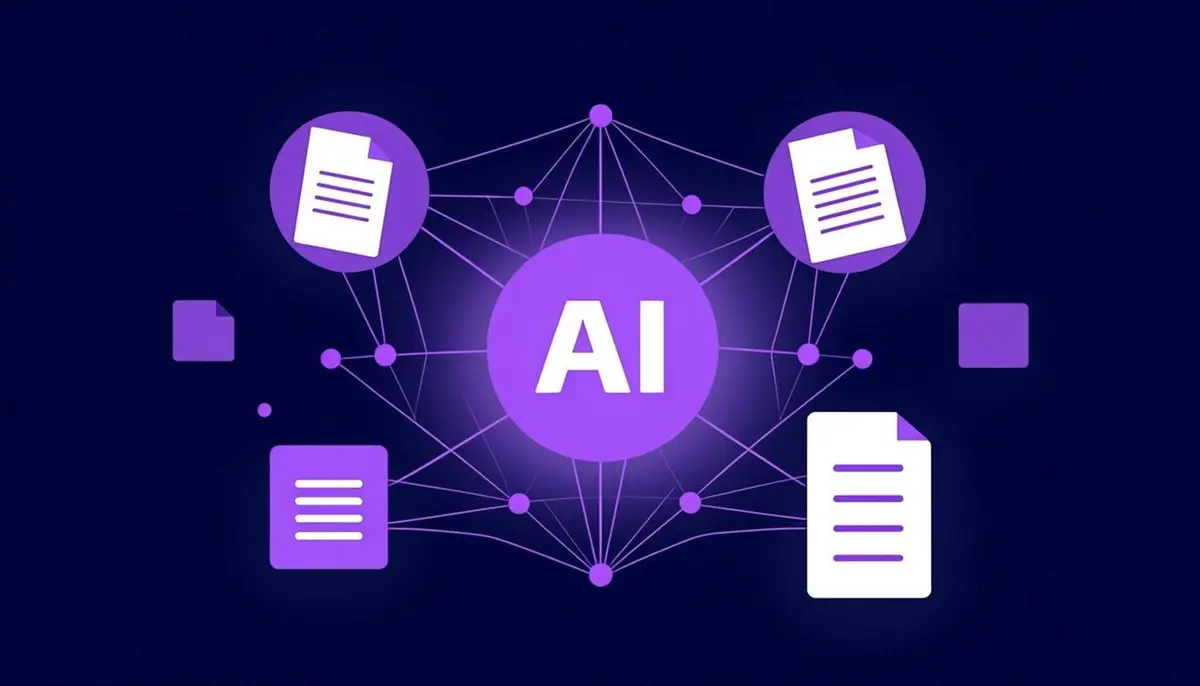
1. Indexing (done once, kept updated). Your documents — PDFs, manuals, policy files, knowledge bases — are split into passages and converted into mathematical representations (embeddings) that capture meaning. These live in a searchable index.
2. Answering (every question). When someone asks a question:
- The system retrieves the passages most relevant to the question
- Those passages are handed to the language model as context
- The model writes an answer based on those passages — and links back to the sources
The result: answers grounded in your content, with references a human can check.
Why this matters for businesses
- Your knowledge becomes askable. “What is our refund policy for enterprise clients?” returns an answer from your actual policy — not a guess.
- Fewer hallucinations. Because the model is anchored to retrieved text, it invents far less — and citations make verification trivial.
- Access control is possible. Unlike a public model, a RAG system can be designed so that only approved, permissioned content is ever retrieved.
- Fresher than training. Update the index and the answers update — no model retraining required.
Where RAG fits well
- Enterprise knowledge assistants for employees — policies, processes, how-tos
- Customer support assistants grounded in your help centre and product documentation
- Sales enablement — instant, correct answers from product specs and pricing rules
- Compliance-heavy document search — contracts, regulations, internal standards
Where it needs care
RAG is powerful, not magic:
- Garbage in, grounded garbage out. If your documents are outdated or contradictory, answers will faithfully reflect that. Knowledge hygiene matters.
- Retrieval quality decides answer quality. Good chunking, metadata and search tuning are most of the engineering effort.
- Sensitive topics need guardrails. Define what the assistant may answer, and route high-stakes questions to humans.
- Evaluation is not optional. A serious deployment includes a test set of real questions with known-good answers, reviewed regularly.
The bottom line
RAG is the workhorse pattern of practical enterprise AI: your knowledge, the model’s language ability, human-verifiable sources. It is also the foundation we most often recommend for a first serious AI deployment — valuable on its own, and a natural base for assistants and automation on top.
If your team loses hours searching for internal answers, an enterprise knowledge assistant is a well-proven place to start.